
Meeting Deep Purple Again After More Than 30 Years
An original Now Spinning Magazine interview with Ritchie Blackmore, recorded exclusively for our 13-part In His Own Words series.
In the first two episodes of Ritchie Blackmore: In His Own Words, Ritchie explained how the idea of appearing with Deep Purple again first came to him, how he almost changed his mind, and what the family journey to the venue was really like.
Episode Three picks up the story immediately after the performance.
For many fans, the sight of Ritchie Blackmore and Ian Gillan smiling together on stage was extraordinarily emotional. This was not simply another guest appearance. It was a moment many people had assumed they would never see.
So I wanted to know what happened when the music stopped.
What was it like for Ritchie to spend time with Deep Purple again backstage? What did Candice and the children make of it? Was there awkwardness, nostalgia or tension?
Ritchie’s answer is wonderfully human, very funny and, perhaps most importantly, unexpectedly warm.
Phil Aston:
The human aspect of the performance was just beautiful.
I think there were grown men and women around the world who had tears in their eyes. It was absolutely magical.
Seeing you and Ian with your arms around each other, both smiling from ear to ear, was wonderful.
Afterwards, when you met the band backstage at the bar, what was it like hanging out with the guys again?
And what was it like for Candice and the children to be there with Deep Purple?
Ritchie Blackmore:
The kids just wanted to go home immediately.
They had no real interest in what the hell was going on, which I kind of liked in a strange way because it took away from the nervous side of things.
Speaking to the band, obviously they were all in great spirits. We were all having fun backstage.
I had been promised some Scotch from Ian, which he didn’t deliver, so thank God I took my own.
I could never go on stage sober.
He is not allowed to drink, I don’t think, because of his diabetic situation.
We were all comparing our illnesses.
I was talking about my gout, my stents in my heart and stuff like that. Ian was talking about his diabetic situation, and Ian Paice had had a stroke a couple of years previously.
So it was like a lot of old men talking about their illnesses, which is okay. That’s what happens when you get older.
I felt very at home.
Obviously there was no thought of me rejoining or doing any of that. It was just a one-off.
It was a great place that I’d always wanted to play at and it was near where I lived.
So it was just a one-off.
I got up on stage, played, went back to grumbling afterwards with the band about our illnesses, and then I went home and they went on their way.
It was a magical night.
It was very good.
In fact, the band was nicer than they’ve ever been when I was working with them.
So it was peculiar in a sense.
They were like old friends who were really happy to see me, and I was happy to see them, which was odd in a way.
But it worked.
I was a little bit concerned about not doing a soundcheck, but my roadie had done the soundcheck and the sound was there, so I was glad of that.
I didn’t know if I was going to walk on stage and have a guitar that wasn’t even plugged in.
I didn’t quite know what was going to happen.
But luckily it was plugged in and I had more or less the sound that I usually play with.
So everything went fine.
Except some of the people in the front row were sitting in water because the actual place tends to acquire water.
For some reason it overflows. I don’t understand what the hell was going on, but people were complaining to me that they were sitting in water.
They didn’t seem to mind.
Actually, everything went very well.
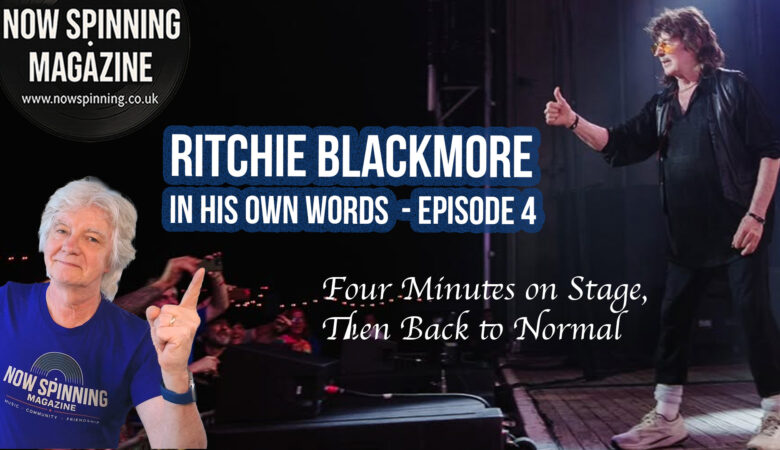
It was very quick and it was over in four minutes.
At first I thought it was going to be like having a dental extraction.
But it wasn’t like that at all.
I enjoyed myself.
And I noticed that Ian Gillan had got taller and I’d become shorter.
Because of my back problem, I have four to five herniated discs that are kind of worn out, which, as you get older, make you shorter.
But — woe is me.
“They Were Like Old Friends”
There are several striking things about Ritchie’s answer, but perhaps the most significant is how relaxed the whole experience appears to have become once the performance was over.
There was no grand discussion about the past.
No summit meeting.
No attempt to rewrite history.
Instead, Ritchie describes a group of musicians who had known one another for decades simply standing backstage, talking, joking and comparing the physical realities of getting older.
His description of it as “a lot of old men talking about their illnesses” strips away decades of mythology in a single sentence.
And yet underneath the humour there is something rather touching.
Ritchie says:
“They were like old friends who were really happy to see me, and I was happy to see them.”
For anybody who has followed the history of Deep Purple, that is probably one of the most revealing observations in the entire series so far.
No Talk of Rejoining Deep Purple
Ritchie is also very clear about one point.
There was no discussion about him rejoining Deep Purple.
He describes the appearance as exactly what it was intended to be: a one-off.
He wanted to play at Jones Beach, the opportunity arose, and he joined the band for “Smoke on the Water”.
That was it.
In many ways, the simplicity of that explanation makes the evening even more special.
There was no strategy behind it.
No attempt to launch another chapter.
It was simply an opportunity to share a stage with old friends again.
“I Thought It Was Going to Be Like Having a Dental Extraction”
Ritchie’s sense of humour runs throughout this answer.
Before walking on stage, he was still uncertain about how the whole thing might unfold.
There had been no soundcheck.
He jokes that he did not even know whether he might walk on stage and discover that his guitar was not plugged in.
And before the performance, he says he expected the experience to feel:
“Like having a dental extraction.”
Instead, he enjoyed himself.
That may be the simplest and most important point of all.
After more than three decades away from Deep Purple, Ritchie Blackmore walked onto the stage, played “Smoke on the Water”, spent a few minutes backstage with the band afterwards — and genuinely enjoyed the experience.
A Very Different Picture of Deep Purple
For years, so much of the mythology surrounding Ritchie Blackmore and Deep Purple has concentrated on conflict, personalities and departures.
Episode Three offers something completely different.
Ritchie talks about Ian Gillan forgetting to provide the promised Scotch.
He talks about everyone comparing ailments.
He jokes about Ian getting taller while he himself has become shorter.
He describes the band as being in great spirits.
And above all, he says they felt like old friends.
Perhaps that is why the performance connected so strongly with people.
It was not about pretending that the past had never happened.
It was simply about reaching a point where, for one evening, none of it needed to matter.
Ritchie Blackmore: In His Own Words is an exclusive 13-part Now Spinning Magazine interview series.
Across the series, Ritchie talks to Phil Aston about Deep Purple, Rainbow, Blackmore’s Night, guitar playing, classical music, family, creativity and his life in music today.
Interview: Phil Aston / Now Spinning Magazine
Editor’s note: This transcript has been lightly edited for clarity and readability while preserving Ritchie Blackmore’s wording, humour and intended meaning.