

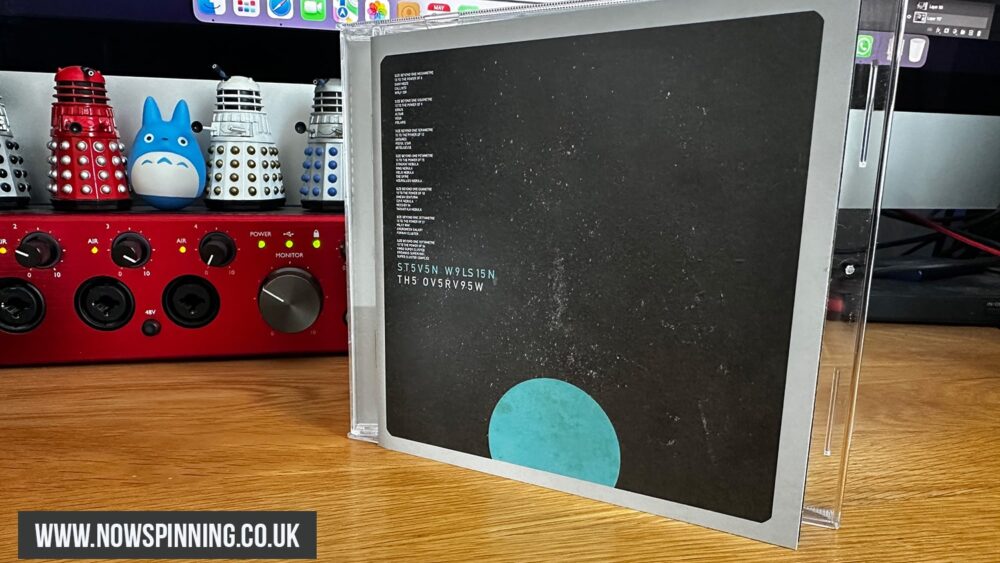

I like to think all of us have things that have impacted us profoundly in some way. I know there are parents, teachers, etc, but I’m talking more about the things we find on our own, away from those influences. Things that shape us, change our lives, and inform our worldviews. The discovery of rock music from the 1960s and 1970s would probably rank as the thing that had the biggest impact on me, which is why I spend my free moments listening to and writing about music. Other than music, there have been the novels of George Orwell and Kurt Vonnegut, the existentialism of Albert Camus, the kindness of Mr. Rogers, and my chance viewing of an old science based tv series called Cosmos.
Cosmos was hosted by the American astronomer, skepticism advocate, science educator, and author, Carl Sagan. It first aired in 1980 on public broadcast. I was about a year old at that time, so I didn’t see it then. No, I first saw Cosmos in 2001 flipping channels late at night, probably searching for something far more titillating and far less educational. As a child I had an interest in outer space, the planets, and in the possibility of life beyond our world. It was something I lost through my teenage pursuits of trying to be cool and gain the attention of the girls, but on this night in 2001, for some reason I stopped on Cosmos and reawakened that kid who wanted to be an astronaut when he grew up.
I’d love to tell you that from that moment, I studied hard and got into a great university and began unlocking the secrets of the cosmos, but that would be a lie. What Cosmos, and in particular Carl Sagan, gave me was a more profound way of looking at the hugeness of everything. The awe in which Sagan spoke about how tiny we were in this gigantic thing we called the universe, made me view life differently. In my late twenties and early thirties, when I grew jaded with, and eventually left religion, it was the lessons I learned from Cosmos that filled that void. Cosmos had taught me, on a much smaller scale, what is known by astronauts as the overview, described by wikipedia as “a cognitive shift reported by some astronauts while viewing the Earth from space.” William Shatner on a flight into space described it as “the strongest feelings of grief,” he had ever felt. The grief comes from truly understanding how fragile earth is and how rare life is, in the vast inky blackness of space. With that realization comes an understanding of how petty and meaningless so much of the ugliness we experience in life really is. It has also been said that the overview effect gives the people who experience it a deeper feeling of connection to the earth, to life, and humanity. It engenders in them a stronger distaste for violence, war, and prejudice.
Now, the reason I am bringing all of this up, is because, modern prog rock musician and producer, Steven Wilson, has recently written, recorded, and released an album called, The Overview. I actually have not had much experience with Steven Wilson, other than hearing the album Fear of A Blank Planet by his band Porcupine Tree, and listening to his many remixes of classic albums by Black Sabbath, King Crimson, Jethro Tull, Chicago, and most recently Pink Floyd’s Live At Pompeii. I’ve enjoyed his work, but never enough to explore his back catalog of albums made both as a solo artist and with Porcupine Tree. However when I heard about his concept for his next album to be called The Overview, my interest was piqued.
Learning that the album was about a point of view, that I had so readily identified with, and one that means so much to me, meant that I was probably predestined to love this record, which of course, I do. Steven Wilson’s The Overview delivers exactly what it promises. It is a profound musical exploration of what Carl Sagan called “the cosmic perspective,” in dealing with the big questions of what Douglas Adams labelled as life, the universe and everything.
The almost forty-two minute album (an appropriate length from a Douglas Adams perspective) is made up of two extended tracks, each with several movements. The first track is a twenty-three minute suite called Objects Outlive Us. The track opens with the line “I incline myself to space,” sung by Wilson in a tasteful falsetto. This introductory movement leads into The Buddha of the Modern Age. Lyrically this section discusses the loss of perspective we are all guilty of as we move through life, being concerned with trivialities, staring at our screens, moving from one dopamine hit to the next, emptily pursuing nothing much until we die, a tiny blip in a massive and unaware universe. This leads to the highlight of the entire suite Objects: Meanwhile, with lyrics written by XTC’s Andy Partridge. Partridge’s lyrics cleverly juxtapose mundane earthly moments with gigantic cosmic events. “Her shopping bag broke sending eggs and flour crashing down to the ground, just like star clusters smashing…” And later, “meanwhile the stars line themselves up in order, while we bicker on with our fences and borders…” Midway through this movement, Wilson plays a wonderfully wall rattling bass solo before the lyrics continue with another perfect juxtaposition, “you queue at the bank for an hour, cos a solar flare blew out the power.” That last bit illustrates just how much the larger universe impacts us more than so many of the smaller things we fret over everyday. A few more movements lead to the concluding Heat Death of the Universe with a perfectly spacey guitar solo performed by Randy McStine.
Track 2 is the album’s title cut. If track one poses the existential problem, track two provides the solution, the so-called overview, the cosmic perspective. This song seems to be from the perspective of an astronaut who is travelling in deep space, at near light speed, exploring distant stars and experiencing the infinite. The suite opens with Perspective, which is musically set to a synth loop as a robotic voice recites the size of some of the universe’s most massive objects. The heart of the suite is in the two sections A Beautiful Infinity I and II. Infinity I finds our astronaut deep in space, far from Earth where his “loving wife’s been dead for years.” He tells us that he sees himself “in relation to it all,” and that “what seemed important now like dust inside the squall.” Infinity II tells us “There’s no reason for any of this, just a beautiful infinity. No design and no one at the wheel, just an existential mystery.”
All of this is heady material for a rock album to be addressing. This stuff can seem depressing, but I think the point of the Overview, both the perspective, and the album, is that of acceptance of the void and the meaninglessness of it all. And then ironically, through that acceptance, we find meaning in living our life aware of our fragility and our transience. Such a perspective can move us to value our lives, our planet, and our fellow humans all the more. We really are all connected in a very real way. Needless to say, I highly recommend this record for its lyrical perspective, its immaculate sound quality, and its transcendent music. I will say though, that this is not an album to be played in the background as you wash the dishes. This is an album that requires your attention. You need to engage with it, and adopt the act of listening as the activity itself, the way you did when you were a kid discovering music. Take forty minutes to yourself, put on this album and stare at the ceiling. Let it wash over you, and let your mind follow its words and message.
I know we’ve kind of veered far away from a typical album review here, but it is rare that a piece of art comes along that can awaken such thoughts and discussion. I just want to end with a pair of quotations that sum up the message of this record “review” and more importantly of Steven Wilson’s remarkable album.
“The cosmos may be densely populated with intelligent beings. But the Darwinian lesson is clear: There will be no humans elsewhere. Only here. Only on this small planet. Every one of us is, in the cosmic perspective, precious. If a human disagrees with you, let him live. In a hundred billion galaxies, you will not find another.” – Carl Sagan
“Our world hangs like a magnificent jewel in the vastness of space. Every one of us is part of that jewel. A facet of that jewel. And in the perspective of infinity, our differences are infinitesimal.” – Fred “Mister” Rogers
Justin Griffin | Now Spinning Magazine





Next to our deepest fears we stand surrounded by million years