
Bruce Soord Opens Up About Loss, Memory and Music’s Healing Power
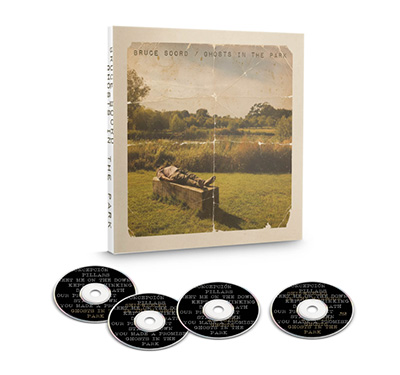
ORDER GHOSTS IN THE PARK DELUXE FROM NOW SPiNN|ING MAGAZINE
Bruce joined me on the Now Spinning Magazine Podcast to talk about his deeply personal new solo album Ghosts in the Park — an album shaped by grief, memory, loss, family, and the strange emotional echoes that certain places and moments leave behind. But what unfolded during our conversation became far more than a discussion about an album. It became an honest reflection on life itself, on losing parents, on memory, and on the way music can help us process emotions that are often difficult to articulate in ordinary conversation.
Watch the full interview on YouTube
From the very start, Bruce explained that this album could only ever have been a solo record. While The Pineapple Thief remains a collaborative creative outlet, Ghosts in the Park came from a far more solitary and introspective place.
“It’s just me trying to make sense of stuff that’s going on.”
As the interview developed, it became clear just how personal this album truly is. Bruce spoke openly about the long emotional impact of Alzheimer’s disease on both his parents — his father’s passing after a decade-long battle, and his mother’s continuing decline over the last twenty years.
And what struck me most was the way he described grief not simply as loss, but as a process of rediscovering who someone truly was before illness changed them.
“You then start to realise who you have lost… I wanted to remember the father that I had when I was a child.”
An Album That Creates Space for Memory
When I first played Ghosts in the Park, I initially experienced it as simply beautiful music — atmospheric, gentle, reflective. But when I sat down properly with the lyrics, something else happened entirely.
The album became cinematic.
It brought back memories of family holidays, walks with my parents, faded colours from childhood summers, and moments I hadn’t thought about for years. The music somehow created enough emotional and sonic space for those memories to emerge naturally.
Bruce clearly understood exactly what I meant.
“I just wanted to try and share what I was going through, knowing that practically everyone has to go through similar things.”
And that is the real emotional power of this album.
It never feels manipulative or overly tragic. Instead, it gently allows listeners to revisit their own memories — not to run away from them, but to sit beside them for a while.
That takes courage as a songwriter.
The Power of Silence and Restraint
One of the things we explored in depth was Bruce’s remarkable use of space within the arrangements.
This is not an album filled with unnecessary layers or bombastic production. Instead, there are moments where the music almost fades into silence before returning again with incredible emotional impact.
Bruce explained that those choices were completely intentional.
“Silence is such a magical thing when it’s surrounded by music.”
It’s a lesson in restraint — knowing when not to add another instrument, another vocal line, another production flourish.
And perhaps surprisingly, Bruce revealed that while making this album he was heavily immersed in the music of Jethro Tull, particularly while working on the Under Wraps remix project and mixing Curious Ruminant.
He spoke passionately about Ian Anderson’s songwriting approach:
“You don’t need to fill it up with all kinds of stuff… You just need hooks, melody, lyrics and emotion.”
Listening to Ghosts in the Park, you can hear that philosophy throughout the album.
Revisiting Jethro Tull’s Under Wraps
Of course, I had to ask Bruce about the hugely discussed remix of Under Wraps.
Like many fans, I’ve always found the original album fascinating but difficult — largely because of its very 1980s production and heavily processed drum programming.
Bruce revealed that they did briefly experiment with replacing the programmed drums with a live drummer.
It didn’t work.
“The song just didn’t make sense anymore.”
Instead, the goal became modernising the sound while remaining faithful to the album’s original identity. Bruce explained that much of the issue wasn’t the drum programming itself, but how dominant the drums were in the original mix.
The remix instead allows listeners to hear far more of the bass, synth textures, flute work and Ian Anderson’s vocals.
And honestly, hearing Bruce discuss the care and respect that went into this remix only deepened my appreciation for the project.
Looking Back at Opeth’s Deliverance
We also briefly revisited Bruce’s remix of Opeth’s Deliverance.
Bruce admitted that revisiting older mixes can be uncomfortable because, as a producer, you’re constantly learning and evolving.
“If I mixed it now, I’d probably do it differently.”
He openly acknowledged that he might now bring the guitars slightly further forward, while still appreciating the greater clarity and bass presence his remix introduced compared to the original.
It’s fascinating hearing an artist reflect on their own work not as something fixed in time, but as part of an ongoing creative evolution.
Music as the Healer and the Doctor
As many of you know, “Music is the healer and the doctor” has become something of a motto for Now Spinning Magazine. During this conversation, I genuinely felt the truth of that more strongly than ever. Because Ghosts in the Park isn’t simply an album about grief. It’s an album about memory. About reconnecting with moments we thought had disappeared. About understanding that sadness and beauty can coexist. And perhaps most importantly, about recognising that we are all travelling through these experiences together.
Bruce Soord has created something truly special here. Not just an album to listen to. An album to experience.
Watch and listen to our other interviews
Phil Aston | Now Spinning Magazine