


Ritchie Blackmore walked onto a stage in New York last night and played “Smoke on the Water” with Deep Purple.
Six minutes. That was all it was.
But sometimes six minutes can contain a lifetime.
This was the first time Ritchie had performed with Deep Purple since 1993. For fans who have followed the band through the triumphs, break-ups, reunions, arguments and changing line-ups, it was something many of us thought we would never see.
I made a video yesterday announcing that Blackmore was going to join the band at the Northwell at Jones Beach Theater in New York. The news had emerged at the last minute and plenty of people wondered whether it might be a joke or whether it would actually happen.
I believed it would.
And it did.
Ritchie Blackmore Walks Back into Deep Purple
Deep Purple were coming to the end of “Space Truckin’” and sounded fantastic. The band were absolutely cooking.
As the song finished, Simon McBride changed guitars and, in the wings, you could see Ritchie Blackmore waiting.
Candice Night was there beside him, her arm around his shoulder. It was a very human moment. You could see the love and support, but perhaps also a little apprehension.
There had been no rehearsal. Ritchie was about to walk in front of a huge audience and play alongside Deep Purple again for the first time in 33 years.
Everyone had a phone. Every note, movement and expression would be filmed, uploaded, replayed and judged before many of those people had even left the venue.
But Blackmore was not going out there to prove anything.
He was walking onto that stage to make music with his old musical brothers.
As he emerged, Simon McBride looked delighted. You could almost imagine what was going through his mind: “I’m going to play ‘Smoke on the Water’ with Ritchie Blackmore.”
What an extraordinary moment that must have been for him.
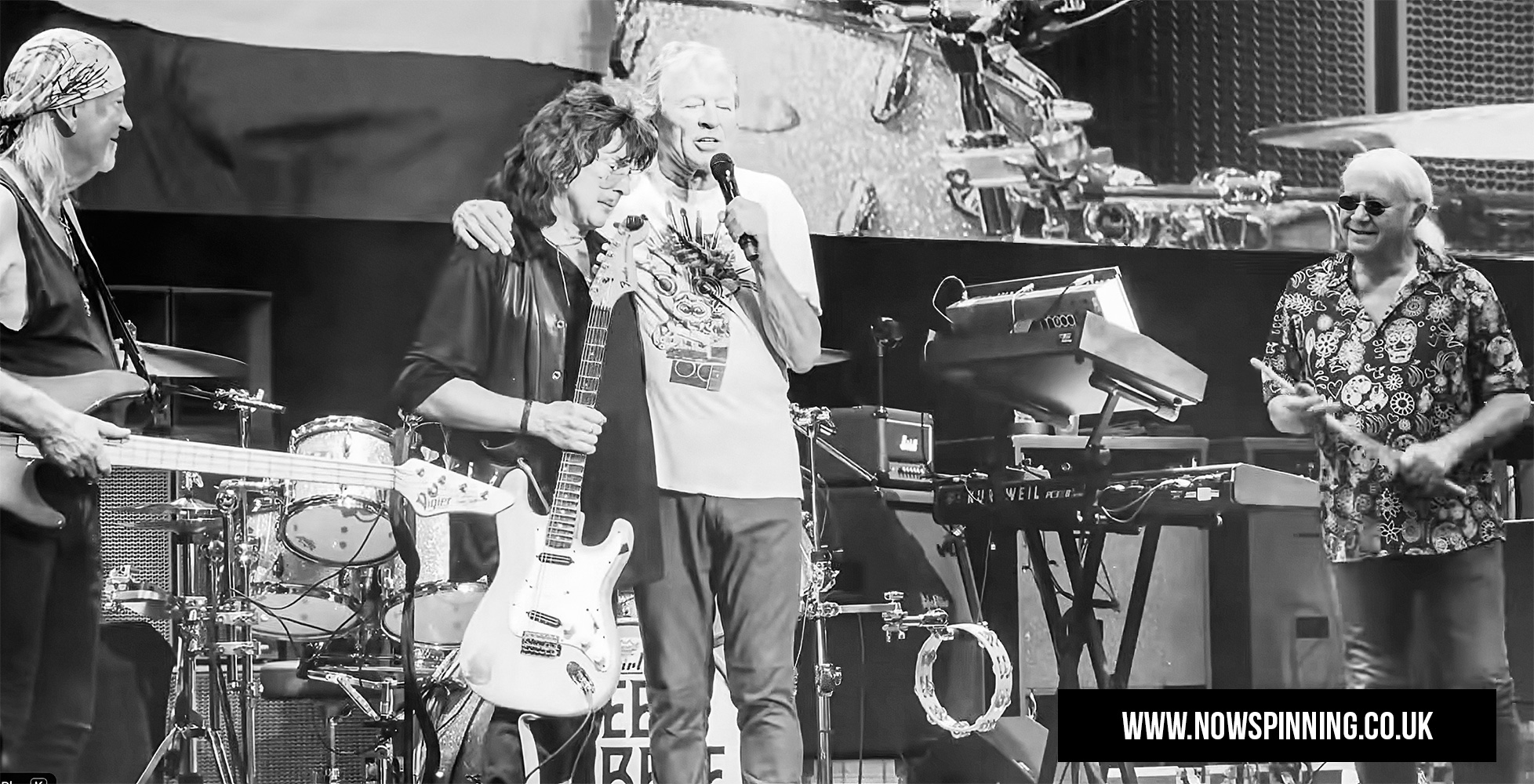
There were smiles and little exchanges between Blackmore and McBride, but it was the interaction between Ritchie and Ian Gillan that affected me most.
When Blackmore began that famous riff, Gillan looked genuinely happy. As the song unfolded, the two men appeared less like former bandmates with a complicated history and more like long-lost brothers who had finally found one another again.
Whatever had happened in the past, they had put it aside.
A Guitar Solo That Served the Song
The original guitar solo on the 1972 studio recording of “Smoke on the Water” remains a masterclass in melody, control and tone.
It is not full of notes for the sake of displaying technique. It comes from a time when a guitar solo was expected to serve the song and deepen its emotional impact.
That has always been at the heart of Ritchie Blackmore’s playing.
People understandably associate him with the classical influences, the dramatic runs and the explosive playing heard on tracks such as “Burn” and “Highway Star.” Beneath all of that, however, there has always been melody, tone and a deep connection to the blues.
Last night, Blackmore returned to some recognisable motifs from the original “Smoke on the Water” solo while adding those slightly Eastern phrases that became part of his playing during the 1980s.
Was he cautious at times? Perhaps.
Was there a little hesitation? Possibly.
Why wouldn’t there be? There had been no rehearsal, and he was rejoining a band whose arrangements have naturally evolved during the three decades since he left.
None of that mattered.
The solo worked because it belonged to Ritchie Blackmore. More importantly, it had feeling.
He was not attempting to compete with Simon McBride or recreate the man he had been in 1972. He was simply playing the song in that moment, as the musician he is today.
It was magical.
They Had Nothing to Prove
During the performance, Blackmore and Gillan stood together, smiling and interacting in a way I cannot remember seeing very often, even during their years in the same band.
At one point, Ritchie took Gillan’s hand and moved it against the fretboard while playing the riff. It was playful, affectionate and completely unexpected.
There was no attempt to pretend that these were still young men in their twenties. Blackmore moved carefully across the stage and took cues from Simon McBride when necessary.
That only added to the emotional impact.
These are musicians approaching or already in their eighties. Time has passed, as it does for all of us. Yet they are still creating moments that bring people together all over the world.
Almost immediately, people began asking whether there might be an album, another concert or even a tour.
I understand the excitement, but I think we need to appreciate what we have just witnessed.
It is later than we think.
This did not have to happen at all. We were incredibly fortunate to see Ritchie Blackmore standing alongside Ian Gillan, Roger Glover and Ian Paice once again.
They have nothing left to prove.
Deep Purple do not need Ritchie Blackmore to validate what the band is today, and Ritchie does not need Deep Purple to validate his extraordinary legacy.
They did this because they wanted to.
That is precisely why it meant so much.
“I’ll See You in the Bar”
At the end of the song, Ian Gillan put his arm around Ritchie and told the audience that he had recently received a message from a “local lad” asking if he could come along and jam with the band.
The answer, of course, had been yes.
Ritchie looked up at Ian and asked: “How come you got so tall?”
“I think you’ve shrunk,” Gillan replied.
There they stood, arms around one another, joking together after everything that had happened between them.
It was not corporate. It was not polished or rehearsed. It was simply human.
Gillan thanked him and said: “I’ll see you in the bar.”
Blackmore then walked to the front of the stage, waved goodbye to the audience and left, no doubt returning to the support of Candice Night.
Those who were inside that venue witnessed something they will carry with them for the rest of their lives.
Music Is the Healer and the Doctor
Perhaps the passing of Ozzy Osbourne, so soon after Black Sabbath’s final concert, has reminded musicians of that generation that time cannot be taken for granted.
Perhaps people are looking at old disagreements and realising that many of them no longer matter.
Life is too short to leave this world with words unsaid and relationships unresolved.
Music brought Ritchie Blackmore and Deep Purple together in the first place. Last night, it brought them together again.
Music is the healer and the doctor. It can cross the years, clear the air and remind people of the bond that existed before everything became complicated.
Some will inevitably say that these musicians are too old and should retire. Frankly, I think that misses the point completely.
Not everyone reaches their eighties. Not everyone reaches the end of their fifties. My own father didn’t, and I have lost many friends along the way.
There are no guarantees.
We should be grateful that these musicians are still here, still playing and still capable of giving us something as moving as this.
I would rather see them rage against the dying of the light than quietly disappear because someone on the internet has decided what people of a certain age should or should not be doing.
Thank You
I want to thank Candice Night. She must have played an important part in making this happen and in helping Ritchie feel that it was the right thing to do.
Watch my interview with Candice Night
Thank you to Ian Gillan for welcoming him.
Thank you to Roger Glover and Ian Paice.
Thank you to Don Airey, and a huge thank you to Simon McBride. His generosity and obvious delight helped make the occasion feel like a celebration rather than an awkward meeting of different eras.
And thank you, Ritchie Blackmore.
I also found myself thinking about Jon Lord. I hope that, wherever he might be, he was looking down and thinking: “At last.”
This was not about perfection. It was not about recreating 1972, competing with the past or proving who could still play what.
It was about forgiveness, friendship, ageing and the enduring power of music.
It was six minutes of “Smoke on the Water.”
And it meant everything.
Phil Aston | Now Spinning Magazine














Hi Phil. I watched Ritchie Blackmore and I’ve watched your review. You were absolutely spot on. This was a monumental music moment and it really was moving to watch.
I have so much to thank Ritchie Blackmore for with regard the decades of top quality music he has given us.
I’m 68, been a Deep Purple fan since I was 16. I thought it was marvelous. Some people have commented by criticizing Blackmore’s playing during the song. They miss so many points. I’ll address several. Blackmore wasn’t there to impress anybody, he was there to be onstage with his old band mates. He’s 81?. He’s an old 81 year old guy. He is aging rapidly at this point. Many people don’t make it to 81, fewer still make it past that age. He is not well physically, and guitar playing is very physical. He also hasn’t been playing rock guitar the last half of his career. He has been an acoustic guitar player. So, he did as well as I expected and it was good enough. We will probably never see this again, so enjoy the moment. Don’t criticize it.