
As a teenager in the 1970s, I was listening to Black Sabbath, Led Zeppelin and Wishbone Ash, while also exploring bands such as Yes, Genesis and Jethro Tull. Gentle Giant seemed to be just beyond the horizon. Their music sounded fascinating, but it also felt complicated and perhaps a little daunting. None of my friends had their albums, so I didn’t have that familiar route into their world. My first Gentle Giant purchase was the compilation Pretentious – For the Sake of It, with its cover showing a safety pin through the Giant’s nose.
Watch the full interview on YouTube
Today, it’s a different story. Like many music fans of my generation, I have caught up. What once seemed difficult to approach now sounds like wonderful, imaginative music, full of detail, humour and humanity.
That made it a real pleasure to welcome Kerry Minnear and Derek Shulman to Now Spinning Magazine to talk about Front Row Center: US Dates 1975–1980, the new eight-CD box set from Madfish. Our conversation took us from the legendary Capitol Tapes and the practical realities of touring America to painted cellos, the pressures of commercial success, memories of Ray Shulman and the musicians discovering Gentle Giant today.
A different view from the front row
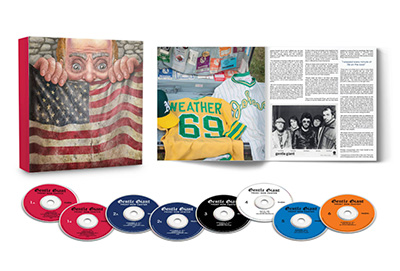
Front Row Center builds on the earlier ten-LP set, expanding the collection to six American performances: five concerts and a session recorded at Capitol Studios in Los Angeles. Across eight CDs, the recordings take us from 1975 to the band’s final touring year in 1980.
Alongside performances from Hempstead, Chester and Atlanta, the CD edition adds the 1975 Capitol Studios session and a previously unreleased 1977 recording from New Paltz. There is also a 60-page hardback book featuring photographs, memorabilia and an essay drawing on interviews with the band.
For existing fans, these recordings offer different performances and arrangements to explore. If you never had the opportunity to see Gentle Giant live, they provide a chance to hear how inventive, energetic and entertaining the band could be on stage.
The Capitol Tapes: “Give me the tapes”
One of the great attractions of this set is the inclusion of the Capitol Tapes, recorded in February 1975. The session had circulated among fans on a bootleg, but the recordings here are taken from the original master and include two tracks that had not previously been released.
Derek explained that, once he had been told about the recordings, he set about getting hold of them.
“I basically persisted in calling Capitol Records and saying, ‘Hey, give me the tapes, give me the tapes.’ And they gave us the tapes.”
The band considered issuing the session as a separate live album before deciding to include it in the box set. Derek was pleased by how good the recording sounded when he heard it again.
He remembers the session taking place in front of an audience of around 50 people. Kerry couldn’t recall the occasion itself, but he had listened to the tapes and enjoyed what he heard: the excitement and immediacy of Gentle Giant playing live, captured with the clarity of a studio recording.
That contrast is part of the fascination. Derek recalled that, despite the people in the room, there is very little audience sound on the recording. The result has a closeness that lets you concentrate on the band’s playing and the way the instruments fit together.
One of the highlights for me is Gary Green’s guitar solo during “Peel the Paint”, which forms part of the session’s closing medley. It is a wonderful reminder of what Gary brought to the band.
A performance even the bootleggers missed
The other major addition is the New Paltz performance from November 1977. According to the release information, it had never been issued and had not even circulated as a bootleg.
Kerry wasn’t aware that the recording existed. Derek explained that fans and other sources sometimes help the band discover material from the past, leading them to go “tape hunting”.
What struck both musicians was that listening back could still surprise them. Kerry spoke about hearing the transitions between pieces and finding moments he had forgotten, while Derek said that even recordings with rougher sound revealed a band who played well together.
There is something rather special about musicians rediscovering their own performances alongside the rest of us. For the listener, those differences between nights are part of what makes a collection like this rewarding.
Another excuse to do something weird
One of the things that makes Gentle Giant such an interesting live band is the way the songs could be reshaped for the stage. Rather than simply reproducing each album track and stopping between songs, they could join pieces together, move between musical ideas and build an arrangement designed for the live show.
Kerry credited Derek and Ray with being particularly sensitive to how a set should flow and how one piece could make a dramatic entrance into the next.
“That gave us another excuse to do something weird,” Kerry laughed. “And we’re always looking for an excuse to do something weird. Let’s face it.”
Those arrangements still leave room for discovery when the musicians hear them again. Kerry mentioned a transition he had forgotten, while we also talked about the changing form of the Octopus excerpts and the use of “Knots” within the live show.
Derek explained that the band thought carefully about stagecraft and about giving the audience something entertaining to watch as well as listen to. That sense of fun is important. Gentle Giant’s music could be extraordinarily intricate, but on stage there was movement, humour and a real desire to connect.
Playing before Black Sabbath — and winning an audience
Before Gentle Giant were regularly headlining, they sometimes found themselves playing to audiences who had come to see a very different sort of band. Kerry remembered an early show supporting Black Sabbath at the Hollywood Bowl, where, he recalled, Phil Shulman had words with the audience. Looking back, Kerry joked that they seemed to behave afterwards.
Derek explained that the band had to think about how to present themselves on those bills. A recorder quartet might not have been the easiest way to win over every hard-rock audience, so Gentle Giant would concentrate on heavier material during a shorter supporting set.
The hope was that some of those people would remember them and come back when they returned as headliners. As Derek recalled, that did happen, particularly in Europe, where the band built a strong following.
Once they had an audience there specifically to see them, there was more freedom to present the full range of what Gentle Giant could do.
Kerry’s white cello
The visual side of the show led us to one of my favourite stories in the box-set book: Kerry’s white cello.
Kerry told me that he had never especially enjoyed being the centre of attention. At some point, a decision was made that his part of the stage would have a white look, including his instruments. He remembered arriving to find that it had already been done.
“I remember turning up and it had all been done.”
He was happy with how it looked, even if painting a cello was not necessarily the best thing for its tone. Kerry joked that, with everything white, he could simply stand there and play.
It is a lovely example of the thought that went into the presentation: a practical solution to the challenge of making a complex band visually engaging, with a little Gentle Giant humour attached.
Life on the road: “We were a workaholic band”
Looking at photographs of the band, the tours and the limousines, it is easy to imagine a particularly glamorous rock-star existence. I asked Kerry and Derek how close that picture was to reality.
Kerry described the band as professional. Gary Green and John Weathers might have stayed up later, he said, but he didn’t remember them being unprepared when it was time to play. And Kerry was keen to make one thing clear:
“I didn’t mind some fun. I did have some fun, honest!”
Derek also challenged the idea that music as adventurous as Gentle Giant’s must have been created under the influence of drugs. The band had to concentrate on what they were playing, and the demands of another show the following day made an endless party impractical.
What comes across instead is the sheer amount of work involved.
“We were kind of a workaholic band,” Derek said. “If we weren’t recording, we were rehearsing. If we weren’t rehearsing, we were writing.”
Looking back, he feels they might have benefited from taking more time off. At the time, though, that work ethic allowed them to maintain a remarkable cycle of writing, recording and touring.
A cauldron of creativity
I was curious about how a band making music of this complexity coped with the deadlines of the 1970s. It was one thing to record and tour regularly; it was another to create and learn arrangements as detailed as Gentle Giant’s within that schedule.
Kerry explained that after a tour and a short break, he, Ray and Derek would work on ideas and share recordings with one another. The songs would gradually take shape before they brought in the rest of the band. Even then, the writing did not necessarily stop when they entered the studio: lyrics, harmonies and other ideas could still be developing as the recordings progressed.
Kerry described the process as a “cauldron of creativity”.
Derek felt that the pressure could be productive. Ideas were presented, questioned, developed and then brought to the rest of the group. He wondered whether having six or nine months to make an album would have produced the same results.
Once the music went on tour, the preparation continued. Derek said they rehearsed the whole show, thinking about how its energy should rise and fall and how to build towards the finale. The set could change occasionally if something wasn’t working, but there was a reason those performances felt carefully constructed.
He also remembered a Los Angeles show at the Shrine Auditorium where the lights came up but the audience would not leave. Gentle Giant returned to play “In the Midnight Hour”, a song Kerry remembered as part of their warm-up routine. His recollection prompted another laugh as he wondered why they couldn’t have been a soul band.
Commercial pressure and the later years
Our conversation moved to the changing music business of the late 1970s. Progressive bands were seeing the landscape shift, while record companies could look at the chart success of other artists and wonder whether their own bands could achieve something similar.
Derek was candid about the band’s more commercial period and his feelings when listening back. He reflected on Giant for a Day and also mentioned “Two Weeks in Spain” and “Betcha Thought We Couldn’t Do It” — both from the preceding album, The Missing Piece — while discussing later live material.
He acknowledged that the performances were well played, but admitted that some of what he heard made him “cringe a little bit”. It is an honest reflection from someone looking back across a long career, although I’m sure there will be fans who feel differently about those songs.
Derek also remembered the pressure to take a further commercial step, but said he was grateful Gentle Giant had not become a Top 40 pop band. He and Ray had experienced pop success before Gentle Giant, and he felt that kind of success could begin to define a band in ways its members had not intended.
Both Kerry and Derek spoke more positively about the material from Civilian on the final tour. Kerry felt that the older and newer music sat naturally together in the show, while Derek agreed that the Civilian songs worked well on stage. The 1980 Atlanta recording in the box gives listeners an opportunity to hear that combination for themselves.
Remembering Ray Shulman
One of the most moving parts of our conversation came when we spoke about Ray Shulman, Derek’s brother and Kerry’s close musical collaborator, who died in 2023.
Hearing Ray across these recordings brings his contribution into sharp focus: the bass playing, violin, arrangements, humour and imagination that were such an important part of Gentle Giant.
“Ray was the heartbeat of the band,” Derek said. “Ray was an incredible creative genius.”
Kerry remembered the humour in Ray’s violin solo and the contrast between the man he knew away from the spotlight and the performer he saw on stage.
“I wouldn’t have said he was a natural extrovert, but he was on stage.”
There was affection in the way both men spoke about him. For Derek, hearing Ray play again brought his brother vividly to life. For anyone listening to the box, it is a reminder of how much personality can live inside a performance.
A band of brothers
Listening to Kerry and Derek talk, I was struck by the friendship that remains between them. They shared an extraordinary amount: the music, the travelling, the hard work and the experience of being young men building something together.
Derek said that members of the band lived in and around Portsmouth and would see one another even when they weren’t recording or rehearsing — going to the pub or fishing together. It mattered to him that, so many years later, he and Kerry were still friends.
He summed up the attitude they brought to the stage:
“We took our music seriously, but we never took ourselves seriously.”
That feels like an important way into Gentle Giant. The music rewards close listening, but there is joy in it too. These recordings capture people who wanted to challenge themselves and entertain an audience at the same time.
A new generation discovers Gentle Giant
I told Kerry and Derek that, for listeners like me, the passage of time can change our relationship with music. An album that once seemed inaccessible can suddenly open up when we return to it with different ears and different life experiences.
At the same time, a younger generation has been finding Gentle Giant online. Kerry finds it rewarding to see listeners of different ages discovering the band, and mentioned watching young musicians and music students performing their work.
He also spoke about the appeal of the analogue era: when the band mixed recordings, everyone could have a job to do at the mixing desk. For Kerry, that sense of everybody being involved was part of the adventure.
Derek is delighted to see younger musicians picking up instruments and taking inspiration from the band. He told me about seeing the French-Canadian duo Angine de Poitrine in New York and meeting them afterwards. They were fans of Gentle Giant, and he enjoyed seeing another generation making adventurous music of its own.
The routes into the music may have changed, but the excitement of hearing something different remains the same.
The Giant on the cover
Before we finished, I mentioned the band’s distinctive Giant image. It has become such a recognisable part of their identity, but its origins came down to a meeting around the first album.
Derek recalled that producer Tony Visconti introduced the band to artist George Underwood, a friend of David Bowie. Underwood created the artwork for Gentle Giant’s debut album, and the image went on to become closely associated with the band.
It is one of those stories where the right people come together at the right moment. Decades later, the Giant remains as recognisable as ever.
Talking to Kerry and Derek was a reminder that there is much more to Gentle Giant than the reputation for complexity that may have intimidated some of us all those years ago.
There is friendship, imagination, hard work and a wonderful sense of humour. There are songs that have changed as the band took them on the road, and performances that still surprise the people who played them.
Front Row Center brings those qualities together. The Capitol Tapes and the New Paltz performance will be of particular interest to collectors, while the wider set gives listeners a chance to follow Gentle Giant through several years of change. For those who already have Unburied Treasure, it makes a fascinating companion; for those coming to the band now, it opens a door onto the live experience.
My thanks to Kerry Minnear and Derek Shulman for their time and for sharing their memories with Now Spinning Magazine.
Gentle Giant: Front Row Center — US Dates 1975–1980 is released by Madfish on 27 November 2026. The eight-CD set is available through the Now Spinning Magazine store
Phil Aston | Now Spinning Magazine