
Steve Morse – Triangulation: Melody, Emotion and the Art of Saying Everything Without Words
On this episode of the Now Spinning Magazine podcast, I had the absolute privilege of talking to one of my guitar heroes – Steve Morse.
Many of you will know Steve from his incredible tenure as the longest-serving guitarist in Deep Purple, his pioneering work with Dixie Dregs and Kansas, and of course the Steve Morse Band, where he continues to blend sheer technical command with heart, melody and imagination.
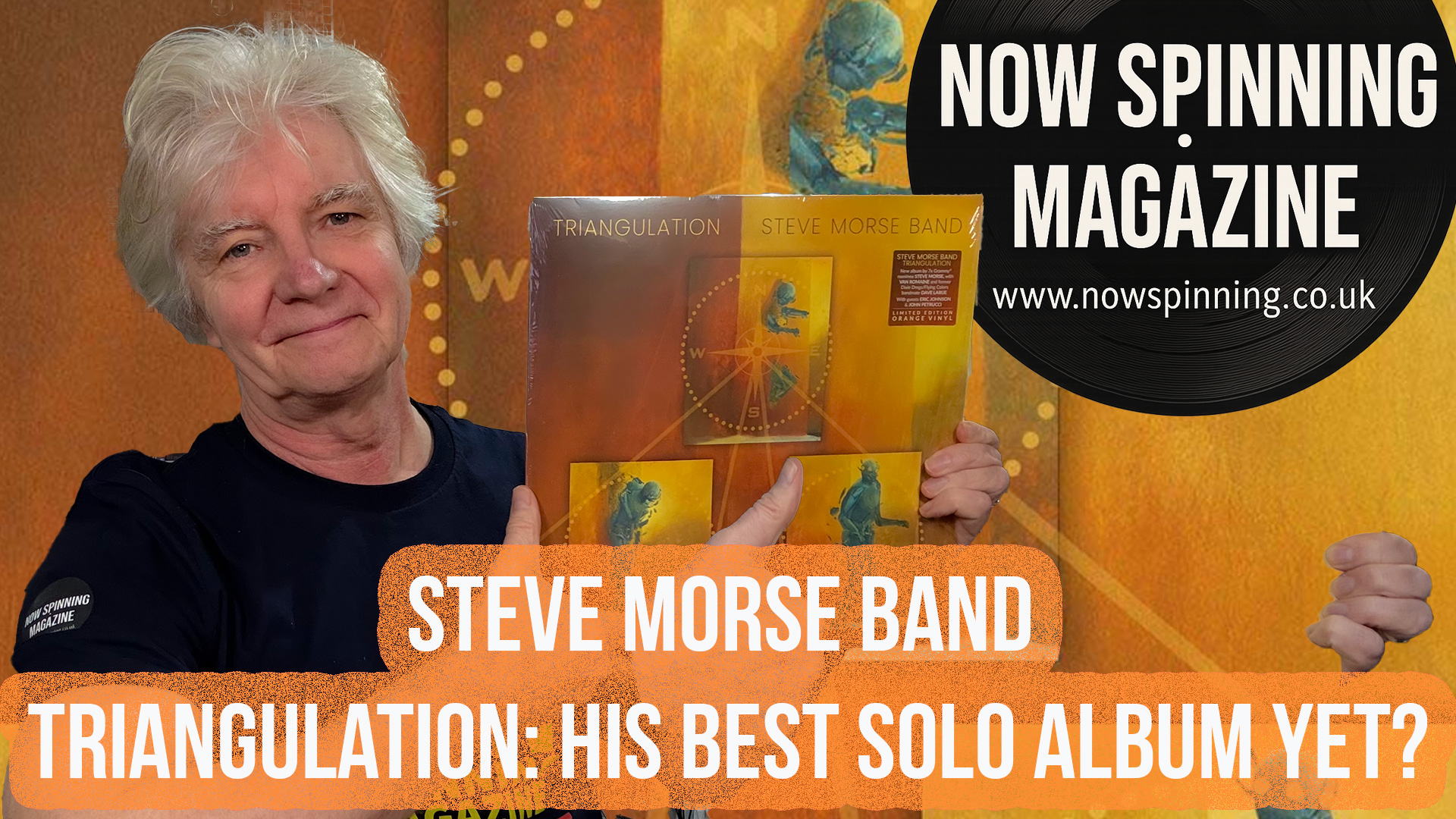
Steve’s new album, Triangulation, is a wonderfully uplifting instrumental record: full of virtuosity, warmth and that unmistakeable Morse sense of melody. It reunites him with long-time musical partner Dave LaRue, and brings in very special guest appearances from John Petrucci, Eric Johnson, and Steve’s son Kevin, who plays on the deeply emotional closing track, “Taken by an Angel.”
This conversation went far beyond gear and technique. We talked about friendship, grief, adapting to physical limitations, and what it means to keep creating music that genuinely lifts people.
“Let’s just wipe the slate clean and do it for us”
From the very beginning, Triangulation was conceived as a “no pressure” record – music made purely for the joy of making it.
Steve explained that he approached this album with the same sense of freedom he felt when he made his classic solo album High Tension Wires:
“The whole idea was to get back… I decided that I was going to get out of the music business and started my album High Tension Wires. It was very freeing to be able to do something where it didn’t matter… that’s the approach we started this with.”
In the age of the internet and shrinking income for recording musicians, Steve made a conscious decision to remove external expectations:
“There was no expectation… my career or life, nothing depended on how this album came out. So it was really like just wiping the slate clean and saying, ‘We don’t have to do anything anyway.’”
That sense of artistic freedom runs right through Triangulation. This isn’t an album chasing trends or radio play – it’s a record built around ideas that excited Steve and Dave, and the fun of pushing each other musically in the studio.
The telepathy of Steve Morse & Dave LaRue
One of the immediate joys of Triangulation is the interplay between Steve’s guitar and Dave LaRue’s bass. This is not a polite “bass in the background” kind of record – Dave’s lines are often co-leads, chasing Steve up and down the neck and weaving in and out of the guitar lines.
As Steve put it:
“Dave’s parts are melody too. I do melody one, he does melody two.”
Rather than writing in the traditional “song with singer” format, much of the material is through-composed, with the instruments themselves taking on the roles that a vocalist might otherwise occupy:
“Unlike a song where there’s a singer and you’ve got a riff and a repetition of a chord sequence… instead of that formula, it’s more like a through-composed bit.”
The way Steve and Dave work together is wonderfully organic. Steve writes with Dave’s playing in mind, and the parts evolve while they’re in the room together:
“He comes over when I get an idea and I show him the idea and I think about him when I write. We play stuff live and while he’s learning the part, I’m adjusting the part I’m going to play with him… we’re interacting like that.”
Sometimes Steve even deliberately writes parts that challenge Dave’s sense of what’s possible on the bass:
“What I enjoy is when I can catch him with a part that he doesn’t think is possible on the bass… I’m like, ‘No, man, you’ve got this… you’re going to have this in 15 minutes.’ And sure enough…”
The result is a record where the conversation between guitar and bass becomes one of the main emotional voices of the album.
“Too Many Parts” – the 11-minute odyssey
One of the standout tracks is the gloriously sprawling, almost 11-minute piece “Too Many Parts.” It begins with high-energy, breakneck riffing, moves through unexpected dynamic and harmonic shifts, and even drops into moments that feel almost minimalist and cinematic.
Steve laughed as he told the story behind the title:
“The longest tune is almost 11 minutes long and I call it ‘Too Many Parts’… decades ago we had a very busy technical exercise starting piece called ‘Too Many Notes’… this one just has too many parts!”
The track is a perfect example of how much variety Steve believes listeners can handle – and enjoy:
“My study of human nature shows that people can tolerate a tremendous amount of variety. In fact, they like it… people will eat off a very big smorgasbord of choices with their ears.”
It’s complex, yes – but never in a cold, mathematical way. It’s constantly shifting, colourful, and, crucially, emotionally engaging.
“Taken by an Angel” – grief, hope and a musical hug
The emotional heart of Triangulation is the closing track, “Taken by an Angel”, featuring Steve’s son Kevin. The piece was written in response to the sudden loss of Steve’s wife, and he spoke very openly and movingly about how it came together.
He began with a section he had originally tried to write as a replacement for “Contact Lost” in Deep Purple’s live set – a piece connected to the STS-107 space shuttle disaster. The band weren’t really picking up on the new idea at the time, so it lay dormant… until tragedy struck closer to home:
“When all this happened so suddenly… my wife went from no visible signs of cancer to 10 days later being in intensive care, and three days later being gone. I retreated to my studio… something sparked me to remember that ending – triumphant, hopeful but sad – and I said, ‘I think I can work with that.’”
Steve wanted the track to feel like a musical painting of those final days:
“I want to make a musical painting of the scenes – starting with me alone… it starts with that really lonely, solitary moment and then moves up a notch, still very sad but with more emotion.”
Kevin wrote a key part of the piece and played with Steve at the memorial, later encouraging him to record it properly:
“My son came up with the part… he really suggested recording it and was a big part of it.”
Despite its origins in grief, “Taken by an Angel” doesn’t feel bleak. It feels embracing – two guitars wrapping their arms around the listener. It’s one of those pieces that many people who’ve experienced loss will quietly adopt as their own.
Writing for instruments instead of a voice
One of the fascinating threads in our conversation was how different it is to write instrumental music compared with writing for a band with a singer.
Steve explained how his writing instincts have evolved over the years. In his earlier days he focused on shorter pieces that would hold the attention of casual listeners walking past an outdoor gig; now, he’s more comfortable stretching out when the music demands it. But perhaps the biggest shift has been towards melody as the guiding force – partly inspired by changes in his hands and technique:
“I’ve shifted from stuff that might be more riff-oriented and more sort of spectacular to play, to ‘I’ve got to come up with stuff that gets me in the heart.’”
On tracks like “The Unexpected”, the counterpoint between guitar and bass almost feels like two cellos in conversation. Steve is always looking for ways to make the music sing without words:
“I love the counterpoint aspect. I’m always trying to make the bass and guitar have counterpoint… from the very beginning.”
The result is that many of these pieces feel like songs, with the listener almost “supplying” the lyrics in their own head.
Petrucci, Johnson and the joy of shared language
Triangulation also features two heavyweight guest guitarists: John Petrucci and Eric Johnson.
Steve admitted he’s usually reluctant to ask friends to appear on his records, worrying they might say yes out of politeness rather than genuine desire. It took a nudge from Sterling Ball (Ernie Ball) to convince him:
“When you ask a friend to do something, sometimes they’ll say yes because they can’t say no… I just never ask anybody. Sterling said, ‘I think it would be a mistake not to.’”
The title track, “Triangulation”, with Petrucci, grew out of a riff Steve felt was almost like an old Dregs idea. He re-arranged the piece specifically to share the melody with John, breaking it up so they could trade and harmonise lines. Petrucci, unsurprisingly, got it immediately:
“He’s just the most unbelievable musical guy… he totally gets it and he’s got total control of his technique. I don’t think you can find anybody that plays his style of music any better than that.”
For Eric Johnson’s feature, Steve reached back to the sound of the 1970s, when they first met in Texas after Eric left the Electromagnets:
“I had a piece already… I heard the music back in the ’70s when I met Eric. I wanted something that reminds me of those days – where he and I can interchange things, play some harmony and our solos are melodic. I basically wrote the tune for Eric to play on.”
The resulting track, “Texas”, is one of the most outright joyous pieces on the album – the two guitars literally sounding like they’re chatting in a shared language.
Adapting to physical limits – and still sounding like Steve Morse
Steve was also very candid about the physical challenges he faces with his hands, and how this is affecting touring and technique.
Right now, his focus is on treatments and on finding a way of playing that will allow him to continue without causing further damage:
“I’m getting more treatments besides the radiation I’ve just finished on my bones. It’s going well, not great right now… If nothing else works, I’m going to revamp my playing, possibly using fingers where I don’t have to use the rotating wrist motion.”
Despite these challenges, he’s determined that the music won’t suffer:
“Now I have to depend on melody… I’ve shifted from stuff that might be more riff-oriented and spectacular to play, to ‘I’ve got to come up with stuff that gets me in the heart.’”
And as any listener to Triangulation will hear: it still sounds absolutely and unmistakably like Steve Morse.
Why Triangulation matters
For me, Triangulation is one of Steve’s finest solo statements – perhaps his best solo album.
It’s complex but never clinical, technical but never cold. It is full of joy, surprise, reflection and warmth, and it quietly carries the weight of real life: grief, adaptation, friendship, and the sheer relief of creating something on your own terms.
As Steve said towards the end of our conversation:
“I can guarantee to you and the listeners that every note in there was put in there with love and dedication.”
If you’re new to Steve Morse’s solo work, this is a perfect place to start. If you’re already a fan, Triangulation feels like the work of an artist who has taken everything he’s lived through and poured it into melody.
Please support the music by getting the album on CD or vinyl if you can. And if you’d like to hear Steve talk through all of this in his own words, do check out the full Now Spinning Magazine podcast episode.
Phil Aston | Now Spinning Magazine