


CD sales, vinyl sales, streaming, physical music, collectability, sound quality and emotional connection — it is all part of the same conversation now.
In this shorter Music Biz Chat episode, I wanted to look at what is happening with CD and vinyl sales in both the UK and the USA, but also ask a bigger question: what are music fans actually buying in 2026, and why?
Because the numbers tell one story, but collectors often tell another.
In the UK, physical music sales grew again during the first half of 2026. According to Music Week’s analysis of BPI figures based on Official Charts Company data, physical album sales were up 3.7% year-on-year, with just over 8.1 million physical albums sold in the first six months of the year.
That alone is encouraging. After years of physical music being written off, people are still buying albums they can hold, play, collect and live with.
But the real story is vinyl.
Vinyl sales in the UK were up 16.4% year-on-year in the first half of 2026, reaching 3,796,251 units. CD sales were still ahead at 4,198,230 units, but they were down 5.2% year-on-year.
So CD is still ahead in the UK — but only just.
The gap between CD and vinyl in the UK for the first half of 2026 is now 401,979 units. In the second quarter alone, that gap was even smaller. Vinyl sold 1,837,536 units, while CD sold 2,050,792 units, leaving a difference of just 213,256 units.
That raises the big question: could vinyl overtake CD in the UK by the end of 2026?
Based on the current trend, it looks very possible.
The price difference is important too. The average cost of a vinyl LP in the UK is reported to be £29.03, while the average CD is £12.24. That makes CD much better value, especially for collectors who want the music, the booklet, the bonus tracks and the archive material without paying premium vinyl prices.
But when we look at America, the story has already moved further along.
In the USA, vinyl has already overtaken CD — not just in revenue, but in physical units sold. According to the RIAA figures reported by Music Business Worldwide, vinyl sold 46.8 million units in the US in 2025, while CD sold 29.5 million units. Vinyl revenue reached $1.04 billion, while CD revenue was $312.4 million. That means vinyl generated more than three times the revenue of CD.
So in America, vinyl is no longer just the more expensive format generating more money per unit. It is also selling more physical copies.
However, we also need to keep the wider picture in mind. Streaming still dominates the US recorded music market. Streaming accounted for 82% of total US recorded music revenue in 2025, and paid music subscription accounts reached 106.5 million.
That means physical music is no longer the mainstream way most people consume music. Streaming is the everyday access point. But physical music is where the deeper fan connection happens.
And this is where the CD versus vinyl conversation becomes really interesting.
Because this is not just being driven by older collectors buying Rumours by Fleetwood Mac, Led Zeppelin IV or Dark Side of the Moon again. Those classic albums are still part of the story, of course, but younger fans are now buying vinyl by the artists they follow today.
They discover the music through streaming, social media, videos, playlists and live shows, but when they want to feel closer to the artist, they often buy the vinyl.
That makes vinyl part music format, part collectable, part merchandise, part artwork and part emotional connection.
I have seen this in my own family. My sons grew up with streaming. One moved from CD into streaming, but now also buys vinyl. The other started with streaming everything, but now buys vinyl as well. Many of their friends do the same.
And when they were asked which format sounded better, CD or vinyl, the answer was very revealing: CD probably has the better sound, but they prefer to buy vinyl.
That is the conundrum.
Why does the technically stronger, cheaper and more convenient format struggle to compete with the older, more expensive and more fragile format?
The answer, I think, is that the physical music market is no longer just an audio market.
If this was purely about sound quality, CD would be in a much stronger position. A well-mastered CD can sound fantastic. It is clean, consistent, reliable and convenient. You put it in the player and it works. No warps, no surface noise, no stylus wear, no cleaning routine, no cartridge alignment and no worries about whether your turntable is set up properly.
CD is still a brilliant format.
But vinyl has something else.
Vinyl has the emotional pull. It has the size, the artwork, the ritual, the sleeve, the coloured pressing, the gatefold, the limited edition, the signed copy, the Record Store Day queue, the sense of occasion.
A vinyl record feels like an event.
It also looks good. It looks good in a record shop. It looks good on a shelf. It looks good in a photograph. It looks good on Instagram. It looks good in films and TV dramas, where you increasingly see characters putting records on turntables, with vinyl shelves in the background.
CD, by comparison, can sometimes feel visually invisible.
That was not always the case. When CDs first arrived, they felt futuristic, classy and convenient. Many of us sold huge parts of our record collections in the 1980s and 1990s because CD felt like the future.
But something has shifted.
The things that once made vinyl inconvenient now make it feel romantic.
The things that once made CD convenient can sometimes make it feel ordinary.
That does not mean CD is worse. It means vinyl currently has more emotional and visual power as a physical object.
And for younger fans who did not grow up with the inconvenience of records, vinyl does not feel like a problem from the past. It feels like a desirable object from the present.
That is why I think vinyl is behaving more and more like premium artist merchandise.
Not merchandise in a throwaway sense, because the music is still central, but merchandise in the sense that it allows fans to show loyalty, identity and connection. You can own the album as an object. You can display it. You can collect different editions. You can have something signed. You can feel part of the artist’s world.
But that also creates a responsibility for labels.
If vinyl is being sold as a premium object, it needs to arrive like a premium object.
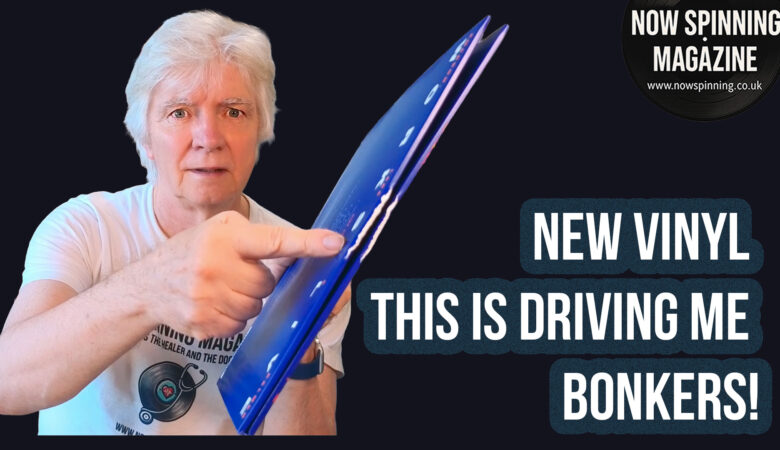
Quality control matters. Pressing quality matters. Packaging matters. Shipping matters. Corners should not be bent. Records should not split the top of the sleeve in transit. Fans paying £30, £40 or £50 for a new vinyl album are not buying an everyday disposable item. They are buying something that feels like a luxury object.
It may not be something they need in a practical sense, but it is something that nourishes them emotionally.
So it needs to be right.
In the Now Spinning Magazine community, I have seen more and more collectors saying they are buying fewer new records because of damaged sleeves, poor pressings or the gamble involved in ordering expensive vinyl through the post. Some are moving back towards CD. Others are streaming more. That should be a warning sign to the industry.
Do not take the vinyl buyer for granted.
At the same time, do not treat the CD buyer as an afterthought.
That is one of my biggest concerns. Too many CDs now feel like they have been put together because the label felt it had to offer the format, rather than because it truly valued the CD audience. A cheap card sleeve, no booklet, minimal notes and a disc that feels like software stuck to the front of a magazine is not good enough.
CD buyers care.
They care about sound. They care about booklets. They care about credits. They care about bonus tracks. They care about archive material. They care about mastering. They care about value.
The CD and vinyl audience are not enemies. They are often the same people.
Many of us buy both.
We choose depending on the artist, the album, the price, the packaging, the mastering, the edition and the emotional connection.
A major box set? CD may be the better option.
A new album from a favourite artist with beautiful artwork? Vinyl may feel special.
A surround mix, Dolby Atmos or high-resolution audio? Blu-ray might be the future conversation.
Physical music should not be forced into a format war. CD and vinyl are brothers and sisters in the same family. If labels try to push fans into choosing one over the other, they risk damaging the whole physical music ecosystem.
The real opportunity is to respect every format.
Make vinyl beautiful, well-pressed and properly shipped.
Make CD collectable, well-packaged and worth owning.
Give Blu-ray audio and Dolby Atmos room to grow.
And remember that the people buying physical music in 2026 are not casual consumers. They are fans, collectors and supporters.
The big question now is not simply whether vinyl will overtake CD.
In America, it already has. In the UK, it may happen very soon.
The bigger question is why.
- Are people buying vinyl for the sound, or for the feeling?
- Are people buying CD for value, convenience and completeness?
- Are damaged records and high vinyl prices pushing some collectors back towards CD?
And is the future of physical music really about giving fans different ways to feel connected to the music they love?
That is the conversation I want to have.
So let me know what you are doing in 2026.
- Are you buying more vinyl?
- Are you still mainly buying CDs?
- Have you returned to vinyl after years away?
- Have vinyl prices or quality control issues made you hesitate?
- Or are you now streaming more and buying only the physical releases that really matter?
Whatever format you choose, the important thing is that music still matters enough for people to want to own it, collect it and feel part of it.
Music is still the healer and the doctor.
Phil Aston | Now Spinning Magazine





I now only buy classic special edition vinyl by legacy bands (boxsets, anniversary deluxe vinyls etc).
Anything else then it’s a cd job or I stream it to see if it’s worth a purchase.
Hi Phil
Interesting peice on vinyl v CD buying.
In answer to your questions:
I still buy vinyl regularly (subject to sufficient funds of course!). I am 68 and would buy all my music on vinyl if I could. However I do my CD’s but have started to replace some of them with vinyl. I have never streamed music and never will.
Would say some CD box sets are excellent and I hope they continue.
In summary, vinyl is still king with me and quality generally is very good but vinyl costs do prohibit buying less than I would like.
Enjoy your articles, keep up the good work, cheers.
Best wishes
Andy
Like so many before me, I sold my voluminous vinyl collection and switched to CDs, retaining a few of my vinyl albums. In the last seven years I largely stream music, occasionally buying CDs. I invested in a first class streamer and speakers as I value quality sound and subscribe to Qobuz.
HI PHIL,
I Buy mostly cds and occasionally lps but the cost of lps is insane! so my focus now is mostly on new and used cds! Thanks
Hello, Phil. I love your site and your channel. However, I feel that you are downgrading the quality of the sound of vinyl, and saying that CDs are better quality sound, and i-Kidz just want vinyl to have something ‘collectible.’ I respectfully disagree. I think vinyl sounds much better and warmer. If you have the right system. In the 70’s, I had a crappy Techniques turntable, and a crappy Nakamichi amp. Of course, there were warts and hairs all over the sound. I now have a Rega turntable, Wilson Audio amp, and Vandersteen Audio speakers.
There is simply no comparison. Plus, I have never spent a dime on any of the new 360 vinyl reissues. Every used record that I own is original. I got stuff, like Happy Jack, Village Green, Electric Ladyland, VU and Nico originals in the early 80’s, when people 20 years older than me were trading their vinyl in. I might add, I paid $3.99 for most of these LPs, in pristine condition (I never bought anything that wasn’t, cover and album for a pittance). Only album I have paid even $50 for was am original pressing of Led Zeppelin II, a Robert Ludwig Mix, 2 years ago at an Amish food shop and record stall in New Jersey. Wonderful, that is. I for one think that vinyl is far superior. It depends on the source, the record, and what you are playing it through, the turntable, speaker and amp. I am still wondering what happened to graphic equalizers from the 70’s. Do not understand why they are not around anymore. Best, David DiPietro, Dallas, Texas…
I was happy buying only cds, having sold all my vinyl years ago. But the release of the gorgeous Topographic Oceans multi format deluxe box set broke me. I’m now slowly and judiciously accumulating a small collection of new vinyl editions of old albums.
I’m also vehemently opposed to streaming.
Phil
my buying habits have changed over last few years. Previously it was all Cd but now Vinyl predominates, mainly from specialist labels like Fruits De Mer. Buy few new releases on vinyl, why buy a Cd master on vinyl, they should be mastered for vinyl. Most vinyl i buy is used, often for £5, filling in gaps of late 60’s early 70’s prog and rock. For Cd it is the box sets that grab me, Madfish do the most superb sets and are worth it, also the Cherry Red box sets collating all a groups albums plus extras, so many difficult to stop buying them, their themed collections are also worthwhile as it has opened up new groups to collect. I do buy some new releases on Cd, but now often wait for a few months and they drop in price and i also get a lot from charity shops, at £1/cd or less, it is worth taking a punt on unknowns. You can pick up some good vinyl form charity shps as well
Personally i buy both formats and stream music as well.
I think CD is much more convenient but i have started slowly building a Vinyl collection in the past years. However, the LP prices now are becoming very high so that makes me buy mostly when i find a good price.
I have a few questions about the sales volumes in the article: 1) do box sets (vinyl or CDs) count as one or as the volume of their discs ? 2) do the CD figures include sales through band sites or bandcamp? 3) similarly, do the CD figures include CDs offered free in magazines (like those in Uncut magazine)?
I started collecting music after I turned twenty, when I finally had the chance to buy records. Before that, I used to borrow CDs from the CD rental shops and record them onto cassette tapes (it was the early ’90s). Around the turn of the millennium I was still too broke to buy original albums, so I burned CDs and even made colour photocopies of the artwork or making my own handmade archive notes.
Eventually I was able to start building my CD collection, right around the time Napster was in its infancy.
Streaming, on the other hand, has always left me fairly indifferent, and I’ve never felt the need to criticise those who embraced it. Music no longer had to be owned in order to be heard, and apart from a bit of nostalgia, I don’t really have much to complain about when it comes to the way times change.
Digitalisation, however, definitely didn’t leave me indifferent. Almost from the beginning I started ripping my CDs with iTunes and, later, with Apple’s Music app, creating a digital archive of my entire collection, carefully stored on hard drives (with multiple backups, of course). That way I always have my music with me. When I’m out, I certainly don’t carry my CDs around (heaven forbid!); instead, I simply load whichever albums I want to listen to onto my phone from my own rips.
But let’s get to the point.
When vinyl came back, I found myself in a bit of a dilemma. Buying both formats didn’t really make sense. Back then people still bought records not just to own them, but to listen to them. It wasn’t the kind of collecting culture we see today. More importantly, my goal was to discover as much music as possible and build a large collection. Buying multiple copies of the same album simply wasn’t for me.
So I started buying a bit of both, CDs and LPs, but something didn’t feel right. I couldn’t understand why until, after giving it some thought, I realised that I instinctively saw the CD as the reference format for my collection.
As beautiful as they were, reissues from Sundazed and other specialist labels never really satisfied my desire to research, discover and collect. CDs, on the other hand, felt like the true museum of the work, especially when they came packed with bonus tracks, detailed booklets, essays, photographs and technical information. Those deluxe editions that started becoming common in the 2000s felt like they were preserving the complete history of an album.
If anything, over the years I found myself becoming less enthusiastic about older CD editions that clearly deserved to be revisited. Thankfully, with a little patience, many of them eventually were.
I’ve often upgraded my CD editions over the years. In fact, today I’m happily buying the new deluxe 2CD edition of Shake Some Action by the Flamin’ Groovies.
I never abandoned vinyl, though. I simply realised what made buying even the most beautiful reissues feel slightly unsatisfying to me. This isn’t a criticism of those who buy them: quite the opposite. Seeing people still buying physical music genuinely moves me, and seeing young people do it even more so. But personally, these luxurious replica editions sometimes feel a little like simulations.
So buying LPs has become something I do only very occasionally, focusing almost exclusively on original editions: first pressings of albums I consider truly essential. For example, I bought a first UK pressing of Shake Some Action as soon as the price on Discogs came within reach. I’ve done the same with albums like Bitches Brew, Tommy, Sgt. Pepper, and a handful of others.
It doesn’t happen often, but I think I’ve found my balance.
The original pressing is the work itself.
The CD is the museum of that work.
And the richer that museum is, the happier the collector in me becomes.