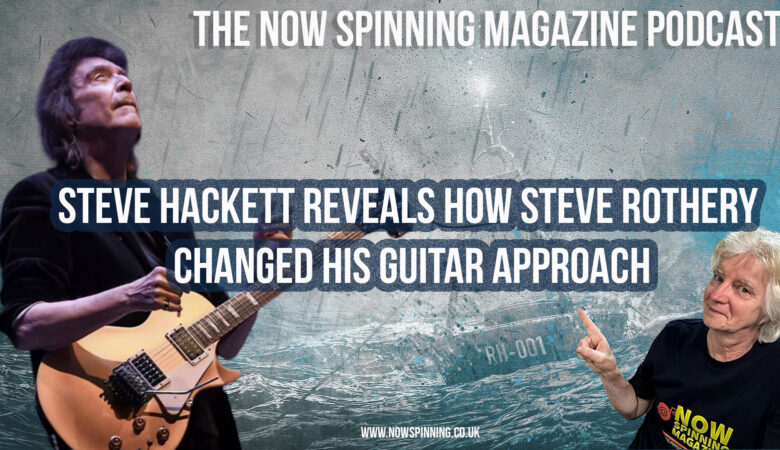

This was my seventh interview with Steve Hackett, and once again I finished the conversation feeling inspired, encouraged and ready to listen to his music with fresh ears.
Watch on Youtube | Spotify | Apple Podcasts
We had last spoken in July about The Roaring Waves, his collaboration with Steve Rothery. This time, with that album now out in the world, our main focus was Steve’s forthcoming Best of Genesis & Solo Gems UK tour: the new musicians joining his band, the freedom of choosing music from across his catalogue, and how he keeps familiar pieces alive.
But, as often happens when talking to Steve, the conversation opened out. We discussed guitars, strings, the challenges of acoustic playing, writing music without an instrument, and how travelling with his wife Jo continues to feed his imagination.
One moment in particular stayed with me. Steve told me that, earlier that very day, he had managed to play something on guitar that he could not play the day before. After everything he has achieved, he is still discovering, still practising and still moving forward. That tells you a great deal about the musician behind this tour.
Hearing The Roaring Waves with fresh ears
Steve is delighted with the response to The Roaring Waves, including praise from people he had not necessarily expected to connect with it. However, one of his favourite experiences came when he briefly heard the album without recognising it.
Arriving at an HMV signing with Steve Rothery, he was distracted by the people around him when music playing through the shop’s sound system caught his attention. His immediate reaction was that it sounded good. Only afterwards did he realise he was listening to their own record.
For someone who has spent so long writing, recording, mixing and listening critically, that small moment offered something precious: the chance to hear the music as a listener.
“If only I could hear it with fresh ears all the time,” he told me.
It has happened before. Steve recalled hearing part of “Can-Utility and the Coastliners” from Foxtrot as he entered the Marquee, admiring what he heard and asking who it was. On another occasion, aboard a music cruise, Jo had to point out that the orchestral music he was enjoying was his own A Midsummer Night’s Dream.
I loved these stories because they take us beyond the technical business of making a record. Even its creator can be surprised by what happens when the music is allowed to exist outside the studio.
A tour with room to explore
The Best of Genesis & Solo Gems tour gives Steve greater flexibility than a show built around performing one particular album in full. He understands the attraction of hearing a complete work, but this format allows him to consider favourites and possibilities across a much wider body of music.
There are, of course, pieces that audiences deeply want to hear. Steve spoke about the requests for “Supper’s Ready” and the sense that leaving it out would disappoint members of the progressive music community.
He also singled out “Spectral Mornings” as perhaps the most requested piece from his solo catalogue. At the time of our conversation, he was still discussing how regularly it might appear, so I would not turn that into a promise about every show’s setlist.
His recollection of recording it was wonderful. Hearing a live take played back through powerful studio speakers in Holland helped him understand its impact. He remembered the importance of Nick Magnus’s keyboard sound alongside the guitar melody, particularly the way Nick had created a substantial pipe-organ effect from a string synthesizer.
It is a reminder that, even when we focus on Steve’s guitar, the emotional force comes from the whole arrangement: the harmonies, the textures, the space and the musicians responding to each other.
New musicians bringing their own personalities
Keyboard player Lalle Larsson and drummer Felix Lehrmann join a touring band that also includes Jonas Reingold, Nad Sylvan and Rob Townsend. Steve’s enthusiasm for the new arrivals was obvious throughout our conversation.
He described Lalle’s combination of classical and jazz abilities, his humour and the sheer excitement of hearing him play. Roger King, Lalle’s predecessor, had described him to Steve as an exceptional player, and Steve’s own comparison reached back to seeing Keith Emerson with the Nice.
What excited him about Emerson was that mixture of virtuosity, musical imagination and theatrical energy. He hears something similarly invigorating in Lalle.
Steve described a piano passage leading into “Firth of Fifth”, with Lalle teasing out musical ideas before approaching the piece in a concerto-like style. On “Ace of Wands”, he has space to take a solo that was previously more of an exchange between instruments.
There is also an opening combination of Lalle’s organ sound and Rob Townsend’s soprano saxophone. Steve explained that the harmonies can change from night to night, bringing an element of surprise to the performance.
Felix, meanwhile, brings what Steve described as a very musical approach to the drums. His enthusiasm is about the character and movement of the playing as much as its power.
The important point is that these musicians have room to contribute. Steve wants authentic performances, while allowing the players to bring their own personalities to the music. That is a very appealing prospect for anyone returning to see him again.
When Amanda joins selected shows, Steve explained, there is also the opportunity to perform the full-length “Shadow of the Hierophant”, approaching fifteen minutes. Her availability depends on her own commitments, so that remains a feature of particular appearances.
Keeping the Genesis legacy alive
We talked about the emotional weight these pieces carry. For many of us, they have accompanied decades of life. A particular melody can bring back a room, a friendship, a concert or the moment we first heard an album.
But Steve also needs the music to remain alive as a performer.
He explained that, once the established phrases at the end of “Supper’s Ready” have been played, he enjoys venturing further with his guitar. The recognisable moments remain, followed by space to explore.
Steve also recalled a conversation with Tony Banks at the launch of Mike Rutherford’s book. Rather than the criticism he had wondered might come, Tony acknowledged that he was keeping the Genesis legacy alive.
For Steve, that sits alongside the need to create new music. He spoke about the danger of “retiring behind the museum doors” if a veteran musician performs only the classics.
His intention is to honour the past and celebrate the future. You can hear that in the way he talks about these performances: affection for the original music, curiosity about what the current band can bring, and a continuing desire to write.
The guitars, the strings and being ready to play
I wanted to ask about the practical side of preparing for a tour, too. Steve explained that he likes rehearsals close enough to the opening shows for the music to remain fresh in his memory.
A Fernandes guitar will be part of his touring equipment, although he had not settled on which one when we spoke. He was hoping his black Fernandes might be ready, describing its powerful sound alongside a feedback problem that needed attention.
For the guitarists watching and listening, there was a particularly useful detail: Steve uses very light electric strings, a set of eights.
He does not change them every night. Instead, he discusses the right time with his guitar technician, taking account of how the strings feel. New strings can seem slightly stiffer to him, and the way his fingertips settle into a tour is another part of the equation.
Backstage, he sometimes has an electric guitar available. There is less spare time on the road than people might imagine, with travel and soundchecks taking up much of the day. He is also careful not to tire his fingertips by doing too much nylon-string playing before a performance.
It is easy to overlook those physical considerations when we see the finished show. The playing depends on preparation, judgement and knowing when to give your hands a rest.
Still learning on a guitar bought in 1974
At home, Steve spends a great deal of time with nylon-string guitar. He enjoys writing music that initially stretches beyond what he can play, then working until his hands catch up with the idea.
He spoke candidly about techniques that can take years to develop. Finger vibrato was one example, with his advice centred on practising slowly and allowing the movement to become controlled rather than forcing speed.
Acoustic guitar presents its own challenges. Electric sustain and distortion can help a note continue singing, while the acoustic player has to work with a sound that naturally fades. Coordinating both hands cleanly takes patience, even for someone with Steve’s experience.
“The fretboard is not a poor second cousin to the keyboard,” he said.
He wants the guitar to suggest the same breadth of harmony and possibility he hears in other instruments.
One of his nylon-string guitars has been with him since 1974, when he bought it for The Lamb Lies Down on Broadway sessions. He was attracted by its depth and its almost piano-like quality. More than fifty years later, it is still helping him discover new things.
Steve also described a G minor sixth tuning that changes the relationships between familiar shapes. Learning its language leads him towards colours he associates with flamenco, jazz and Russian music.
When I suggested that this was like mixing colours on a palette, he spoke about his father, who painted thousands of pictures. Music is Steve’s own way of painting the world.
Then came the moment that summed up the interview for me: he had been working that day on something he could not play yesterday, and today he could play it to his satisfaction.
That is an encouraging thought for anyone who creates anything. There is still something to discover. There is still another step to take.
Life on the road and music arriving on the page
Steve was refreshingly honest when I asked about staying mentally focused while touring. He did not offer a neat routine. Much of life on the road is taken up by travelling, particularly across the larger distances in America.
At home, he and Jo follow the news, despite how troubling it can be. On tour, the work naturally occupies more of his attention. A book offers another place to put his mind, and he was planning to take one about Maria Callas with him.
His answer about listening to music while travelling surprised me: most of the time, he does not.
Instead, when he has no instrument available, he may write music down on the page. He reasons that if an idea works in that relatively cold medium, it has a chance of coming alive when musicians play it.
Some ideas come from experimenting on guitar, but a melody can also arrive independently. Steve described seeing one of nature’s wonders while travelling and immediately hearing a theme in his head. Out came the notepad.
He credited Jo with encouraging that spirit of exploration. Their experiences of the world, including places beyond the usual touring routes, continue to feed his musical imagination.
A musician still looking forward
Steve briefly touched on further recording work, including a rock project and the possibility of an acoustic or acoustic-orchestral direction afterwards. What came across most strongly was his continuing urge to write, with release plans a separate consideration from the music itself.
That creative energy runs through the entire conversation. Genesis remains an important part of his musical life, while his solo work and his daily exploration of the guitar keep opening new doors.
As he said near the end, “It’s just music.” The labels matter less than what a piece can make us feel.
I came away from this seventh conversation admiring Steve even more. He is preparing to bring much-loved music to audiences again, with musicians who have space to make their mark, while still finding something new in an instrument he bought more than half a century ago.
The Best of Genesis & Solo Gems UK tour runs from Cambridge on 2 October 2026 to the Royal Albert Hall on 26 October. For dates and ticket information, visit Steve Hackett’s official website.
Watch or listen to the full Now Spinning Magazine interview for a warm, wide-ranging conversation about the tour, the music and the curiosity that keeps Steve moving forward.
View and search all our artist PODCASTS
Phil Aston | Now Spinning Magazine